
Geomagnetic shielding
Earth's magnetic field turns away cosmic rays and solar particles below a threshold that depends on where you are. It is why low, low-inclination orbits are sheltered and polar passes are not.
What it is
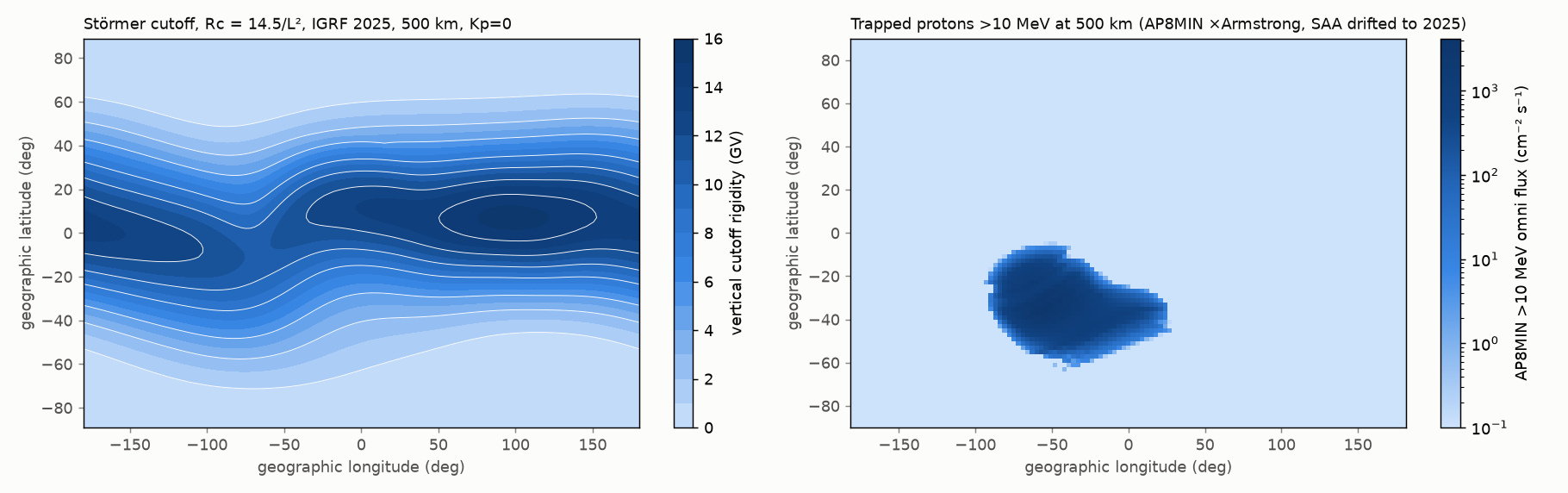
A charged particle arriving from space is bent by Earth's field. How easily it bends depends on its rigidity, momentum per unit charge, in gigavolts (GV). At each point there is a cutoff rigidity: particles below it are turned away, particles above it get through.
The cutoff is highest near the magnetic equator, about 15 GV, where only protons above about 14 GeV arrive. It falls to zero near the magnetic poles, where field lines open to space. So an orbit at 51.6° inclination spends part of each revolution well shielded and part almost exposed, and the same solar storm can be a non-event at the equator and a hazard over the poles.
Earth itself also blocks part of the sky: about a third of it at 400 km.
How we model it
- Method
- Størmer cutoff, 14.5 GV / L², on IGRF McIlwain L; shifted 0.75° of latitude per Kp step; open above L = 5.
- Checked against
- Smart & Shea trajectory-traced grids.
- Expect
- 10 to 20 % in cutoff rigidity.
- Cutoff. The Størmer formula, R_c = 14.5 GV / L², with McIlwain's L from the International Geomagnetic Reference Field Smart & Shea (2009) Baldini (2014).
- Storms. The cutoff latitude moves toward the equator by about 0.75° for each step of the Kp index Shea & Smart (2015).
- Open field lines. Above L = 5 there is no shielding, following the ECSS standard ECSS-E-ST-10-04C. This can be switched off.
- The edge. A real cutoff is not sharp; there is a band of rigidities where some directions are open and some closed. We use the smooth step 1 / (1 + (R/R_c)⁻¹²), with exponent 6 for electrons and positrons Cumani et al. (2019).
- Earth's shadow. The solid angle of the planet and 100 km of atmosphere is removed.
- The magnetopause. Its shape follows Shue et al. Shue et al. (1997) and responds to solar-wind pressure and the north-south field component.
Assumptions and limits
- The Størmer formula gives the cutoff for vertical arrival in a dipole-like field. Against grids computed by tracing trajectories, expect 10 to 20 % in the cutoff.
- The cutoff depends on arrival direction: at a given point, particles from the west get in more easily than particles from the east. We use the vertical value for all directions.
- The storm shift is a rule of thumb from a workshop abstract.
- The 3D explorer draws cosmic-ray access with a pure dipole, R_c = 14.5 cos⁴λ / r² GV.
Sources
| Used for | Source | Basis |
|---|---|---|
| Rc = 14.5 GV / L² (Störmer, vertical) | Baldini (2014); Smart & Shea (2009) Smart & Shea; as given in the Baldini (2014) review, arXiv:1407.7631 Eq. 33 | primary/review |
| Kp shift, ~0.75° invariant latitude per Kp step | Shea & Smart (2015) Invited abstract "Geomagnetic cutoff rigidity values are a valuable tool…" | primary (abstract) |
| No shielding above L = 5 | ECSS-E-ST-10-04C §9.2.4 (Stassinopoulos & King) and Annex I.4 | standard |
| Penumbra sigmoid 1/(1+(R/Rc)^−12) (p, ions), exponent 6 for e± | Cumani et al. (2019) | secondary compilation |
| Magnetopause | Shue et al. (1997) | primary |